Michel de Seure served as Henri II’s ambassador in Lisbon from 1557 to 1559. His reports on Atlantic shipping and Spanish war finance were partly enciphered (Potter 2014, pp. 7–9).
We reconstructed a partial key from a letter preserved in both cipher and clear French, then tested it on other passages. It also gives a tentative reading of a dispatch in which Seure seems to say he wants to leave Lisbon after two years.
Devin O’Keefe published transcriptions, a key, and a partial reading of item 39 first. He also identified the decipherments and NAF 6638 copy used below. Our contribution is to test a separately fitted key and compare our initial reading with his.
The letters
BnF Français 3151 contains two copies of Seure’s 12 December 1558 letter to Henri II: items 43 and 44. A passage enciphered in 43 appears in clear French in 44. That pair supplied our training material. Gallica view numbers differ from manuscript folio numbers.
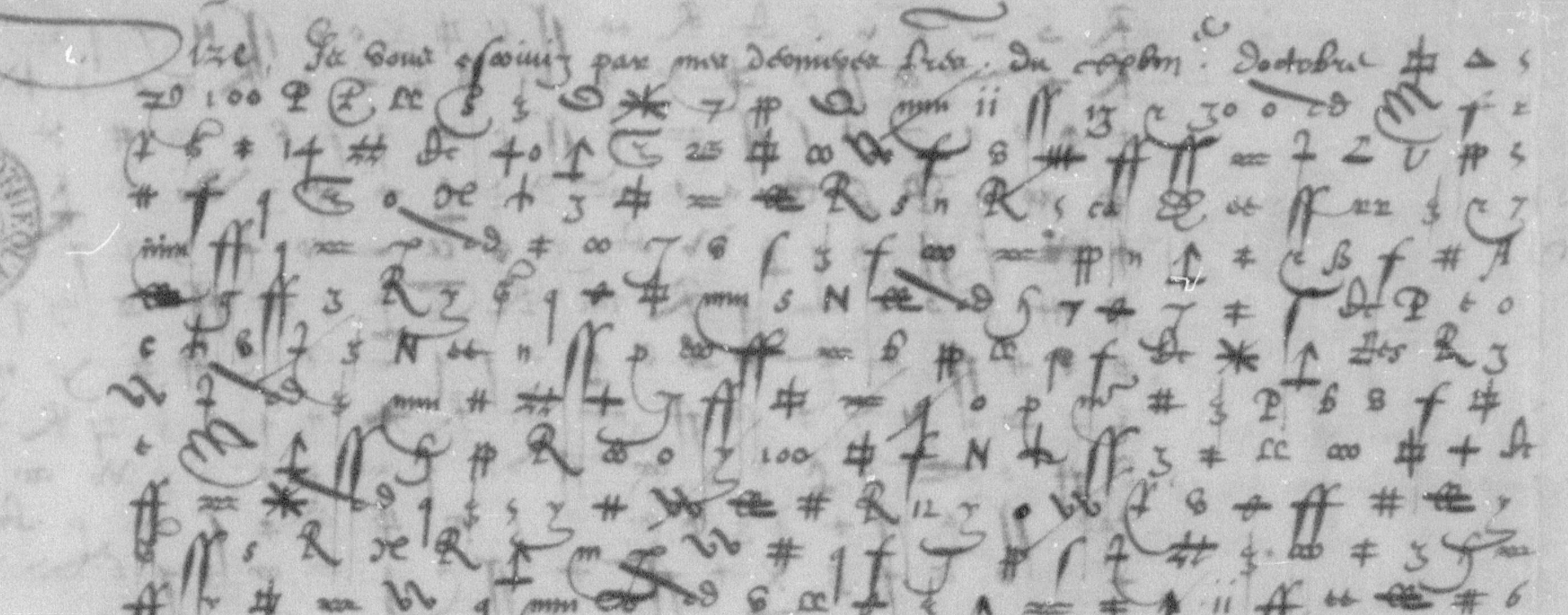
Item 43: a clear opening followed by cipher. Gallica, view 81. Source: gallica.bnf.fr / BnF.
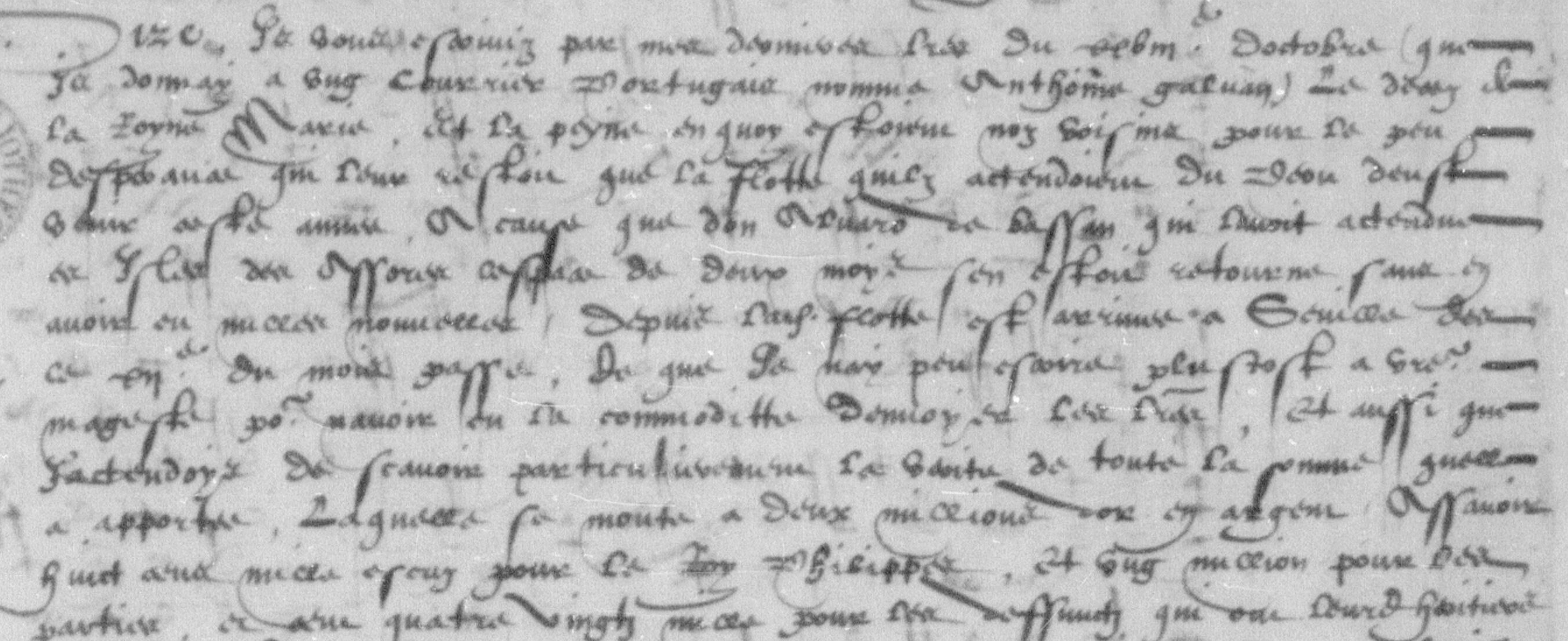
Item 44: the same passage in clear French. Gallica, view 85. Source: gallica.bnf.fr / BnF.
Building the key
The cipher mixes signs for letters, syllables and whole words with nulls. Aligning the copies gives values such as tac → nauires (“ships”), repeated four times, and R → de. Here tac and R are labels for drawn signs.
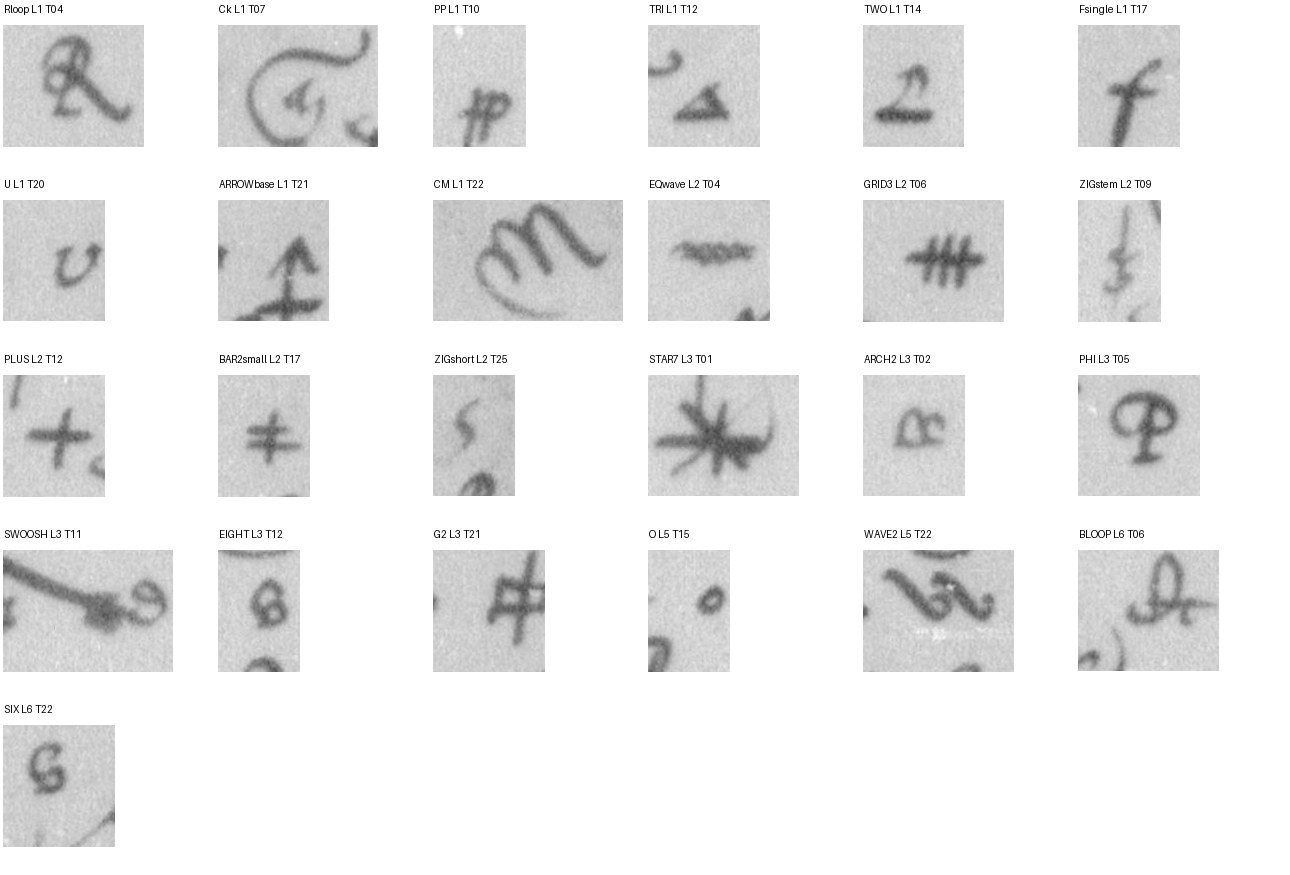
Early sign inventory from Gallica, view 83. Labels identify shapes, not readings.
Some errors came from merging similar signs. Separating a looped variant from a cross-shaped sign improved decoding on held-out passages. Touching strokes were harder: where a scan allowed more than one boundary, we kept the alternatives.
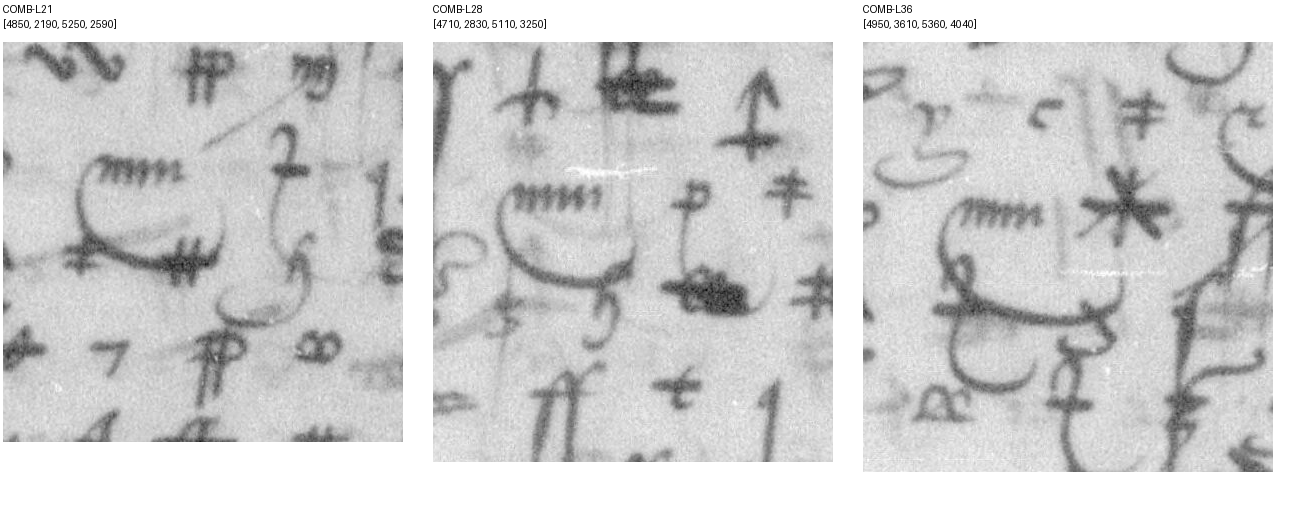
Three ambiguous forms from rows 21, 28 and 36 of Gallica, view 81. Touching strokes need not form one sign.
Testing the key
Our first tests were flawed: test passages overlapped training data, reserved signs had influenced label definitions, and test scores had guided run selection. We discarded those results. Agreement between cipher copies was also insufficient: any consistent key can produce it.
Language-model agents transcribed several test passages from image crops without the corresponding plaintext. Before scoring, we froze and checksummed every test transcription and key, specified the pass rule, and selected solver runs using training scores alone.
We aligned each output with known plaintext, scoring +2 for a matching letter, −1 for a mismatch and −1.5 for a gap. The baseline was 200 keys with shuffled values.
The percentages below measure matches within aligned stretches, not the proportion of a whole letter deciphered. Beating random keys supports the key; it does not verify every reading.
Item 40 is Seure’s 27 December 1558 dispatch. Fol. 85r–v contains the decipherment of the three remaining cipher blocks in his 12 December letter.
Test | Score (best of 200 random keys) | Letters matched in aligned span |
|---|---|---|
Frozen key on item 40, fol. 73r, against fol. 74r | 305.5 (30.0) | 292 of 465 (63%) |
Frozen key on item 40, fol. 73v, against fol. 74r | 472.5 (29.0) | 483 of 799 (60%) |
Frozen key on the 12 December letter’s three cipher blocks, both copies, against fol. 85r–v | 182.5–900.0 (30.0–33.5) | 53–69% |
Key fitted only on item 40, on item 43’s opening, against item 44 | 811.5 (38.0) | 877 of 1,509 (58%) |
The strongest check was the reverse test: a key fitted only to item 40 read item 43 and all six fol. 85r–v blocks without training on them. Two independently fitted keys could read each other’s dispatches.
An unedited fragment from item 40, aligned with its decipherment (bars mark matches; hyphens mark gaps):
key output  depo-uoicenulolestrrnlisledelataoneranauireser-rz-co-lscierspou
            |||| ||| ||| | |  | |||||||||||   |||||||||| |  |  |   ||||||||
fol. 74r    depouuoirenu-oye--renlisledelaterceranauiresarmezetofficierspou
The reference text means “…to send armed ships and officers to the island of Terceira…”.
Other tests were weaker: a wrongly identified plaintext failed, a postscript barely beat the random controls, and one refit initially performed worse than the frozen key.
On NAF 6638, a nineteenth-century copy of an early-1559 dispatch, a refined key matched 63–67% of reference letters against Falgairolle’s 1895 plaintext. It beat random controls but underperformed the original key on two of three passages. A later refit reached 63–71%; we had already seen the earlier test scores, so that comparison is weaker evidence. We used the later key for item 39.
Reading item 39
Item 39 is Seure’s 12 December 1558 letter to de Fresne (fol. 71r, Gallica view 72). No decipherment is known. The key gives:
“… ie ne [ueux] plus demeurer … guieres longuement … que acheuer mes [deux] ans …”
“…I [do not want] to stay … much longer … than to finish my [two] years…”. Brackets mark tentative readings; dots mark gaps. The opening remains fragmentary and rows 2–3 unread. His known two-year posting fits this reading, but is not independent support: it could have influenced our choice of [deux].
We froze our first reading before comparing it with O’Keefe’s independent transcription and key. Fifty of its 74 words (68%) appear in his reading on the same or an adjacent row. Later revisions incorporated some of his sign data, so their higher agreement is not independent evidence.
What remains uncertain
Language models also proposed words to fill gaps. We rejected desire for deulre because the signs did not support the required changes. Fluent French is not enough.
Ambiguous boundaries, transcription errors and rare sign values still limit the reading. We keep the transcription, key values and interpreted French separate, so a plausible sentence cannot become evidence for its own decoding.
Sources and credits
- David Potter, introduction to A Knight of Malta at the Court of Elizabeth I, Royal Historical Society Camden Fifth Series 45 (2014), pp. 1–33. doi:10.1017/S0960116314000025.
- BnF Français 3151 on Gallica; BnF NAF 6638 on Gallica. All manuscript images: Source gallica.bnf.fr / Bibliothèque nationale de France.
- Devin O’Keefe, seure: transcriptions, key, and item 39 reading, used under CC BY 4.0.
- Edmond Falgairolle (1895): printed plaintext of the NAF 6638 dispatch.
No comments yet